Women 40+
Perimenopause and Menopause Fitness: What Changes, What Doesn't, and How to Train for Strength, Bone Health, Energy, and Confidence
Perimenopause and menopause can change how exercise feels. They can affect sleep, temperature regulation, recovery, mood, menstrual patterns, energy, and body composition. But menopause does not suddenly make strength training useless, cardio dangerous, or meaningful progress impossible.
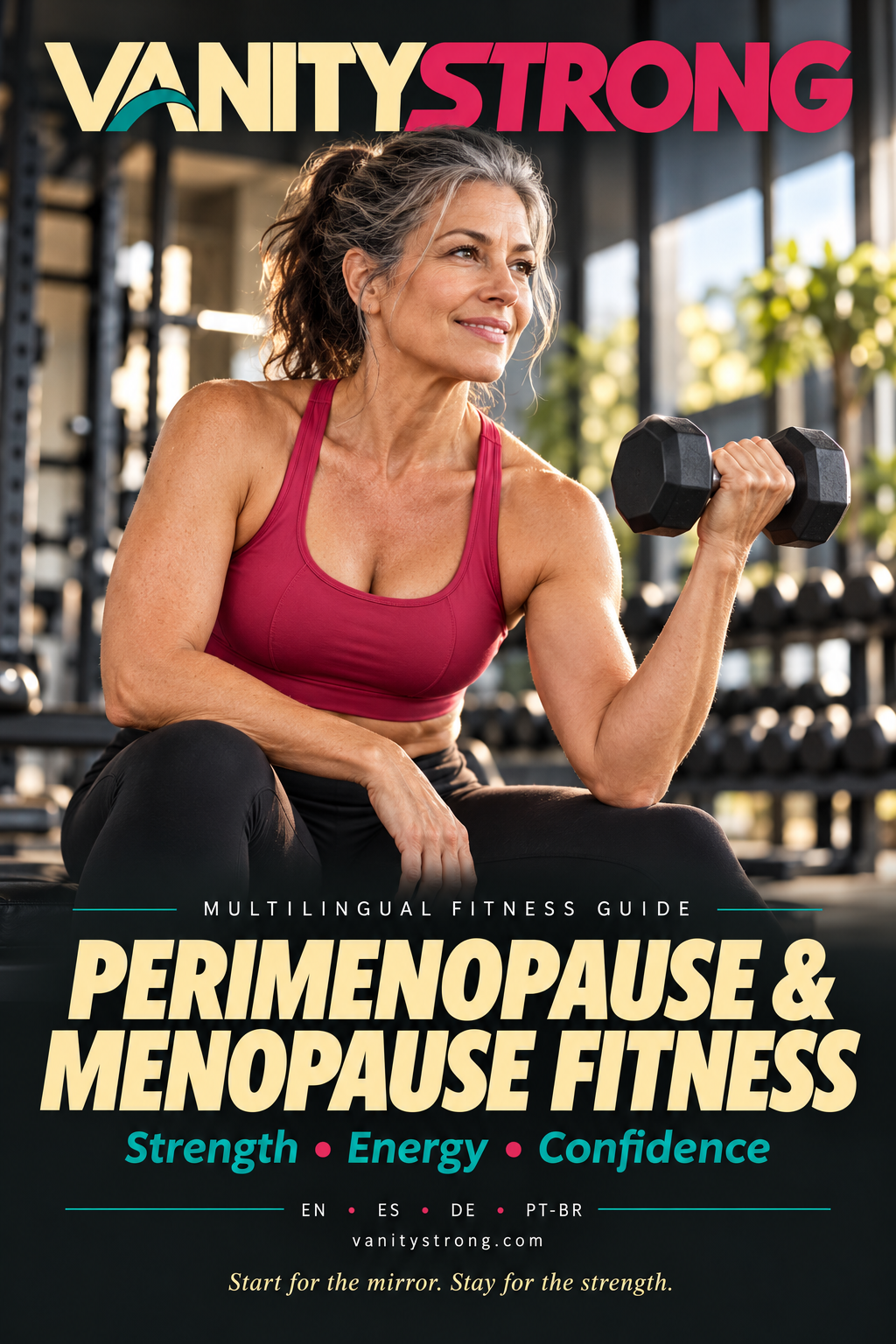
Available in all 8 site languages. Choose a language for its own PDF.
Find a practical starting point
Take the VanityStrong Fit Quiz for a starting place that fits your schedule, equipment and goals.
Perimenopause and menopause can change how exercise feels. They can affect sleep, temperature regulation, recovery, mood, menstrual patterns, energy, and body composition. But menopause does not suddenly make strength training useless, cardio dangerous, or meaningful progress impossible.
It does mean that fitness may require more attention to recovery, bone health, muscle preservation, sleep, and realistic expectations.
That distinction matters.
A lot of women reach their 40s or 50s and assume that every change in weight, strength, sleep, or energy means their body has stopped responding. Online fitness marketing often makes the problem worse by selling menopause as either a catastrophe or a secret metabolic code that requires a completely different form of exercise.
The reality is more practical.
What actually changes during perimenopause and menopause?
Perimenopause is the transitional period before menopause, when ovarian hormone production becomes less predictable. Menopause is reached after 12 consecutive months without a menstrual period when there is no other cause.
Symptoms vary widely. Some women experience hot flashes, night sweats, disrupted sleep, mood changes, vaginal symptoms, irregular periods, or changes in energy. Others have relatively few symptoms.
One of the most important long-term changes involves bone. Estrogen helps protect bone tissue. As estrogen falls around menopause, bone loss can accelerate. ACOG notes that rapid bone loss begins around the final menstrual period and is particularly important during the first several years after menopause.
Muscle also deserves attention. Muscle mass and strength naturally become harder to preserve with age if they are not challenged. That is one reason resistance training becomes more - not less - useful in midlife.
Strength training should be a foundation
Strength training means asking your muscles to work against resistance. That can come from dumbbells, machines, resistance bands, cables, body weight, or other loads.
The goal does not have to be powerlifting.
A good program trains the major movement patterns: squatting or sitting and standing, hinging at the hips, pushing, pulling, carrying, and stabilizing the trunk.
For most adults, public-health guidance recommends muscle-strengthening exercise at least twice per week alongside aerobic activity.
Strength training matters during and after menopause because it can support muscle strength, function and bone health. Weight-bearing and resistance exercise are specifically recommended for helping maintain bone strength.
Progress does not require destroying yourself in the gym. The useful question is whether your training gradually asks your body to do a little more over time.
That might mean five additional pounds on a movement, one extra repetition, an additional set, a harder exercise variation, or better control through the same range of motion.
Cardio still matters
Cardiovascular training did not become obsolete when you turned 45.
Walking, cycling, swimming, rowing, dancing and other forms of aerobic activity can support cardiovascular fitness, metabolic health, endurance, mood, sleep and overall health.
Adults are generally advised to work toward 150-300 minutes of moderate-intensity aerobic activity per week, or an equivalent amount of vigorous exercise, along with strength work. People starting from a lower activity level can begin with smaller amounts and build gradually.
You do not need to choose between cardio and weights.
They solve different problems.
Strength training gives muscle and bone a reason to remain strong. Cardio improves your ability to sustain movement and challenges the heart and circulatory system. Walking is also an accessible way to raise total daily activity without turning every session into another hard workout.
Bone health changes the conversation
Bone health is one of the strongest arguments for not treating midlife fitness as purely a calorie-burning project.
Weight-bearing exercise, resistance training and balance work all have roles. NIH guidance identifies activities such as brisk walking, stair climbing and dancing as weight-bearing options, while resistance work challenges muscles and bones. Balance training can help reduce fall risk.
If you already have osteoporosis, osteopenia, a history of fragility fracture, significant back problems or another condition affecting exercise safety, the correct program may need modification.
Harder is not automatically better.
What about weight gain around menopause?
Some women notice that maintaining the same body weight or body composition becomes harder during midlife. Sleep changes, activity levels, age-related muscle loss, dietary habits, stress and hormonal changes can all interact.
That does not mean one special exercise burns "menopause fat."
Spot reduction still does not work, and no particular workout can selectively remove abdominal fat.
A more useful strategy is to protect muscle through resistance training, maintain regular aerobic activity, keep general movement high, eat in a way that supports your goals and choose an approach you can repeat long enough to matter.
Recovery is training too
Someone who slept four hours because of night sweats may not train exactly the same way as someone who slept eight.
That is not failure.
If recovery is poor, you can reduce volume without abandoning the habit. A heavy session can become moderate. A 45-minute workout can become 25. A planned interval session can become a walk.
Consistency is not doing the identical workout under every circumstance. Consistency is continuing to make useful decisions when circumstances change.
A practical week
A realistic menopause-friendly week might include two or three full-body strength sessions, several moderate walks or other cardio sessions, and regular light movement throughout the week.
A beginner might train strength on Monday and Thursday, walk briskly Tuesday, Friday and Saturday, and use Wednesday or Sunday for mobility, recovery or easy movement.
Someone more experienced might lift three times, perform two intentional cardio sessions and still use walking as lower-intensity activity.
There is no universal menopause split.
Your training history, symptoms, schedule, injuries, goals and preferences matter more than an internet template.
What if hot flashes or fatigue make exercise harder?
Modify the environment first.
Train in a cooler room. Use breathable clothing. Hydrate appropriately. Move hard sessions to the part of the day when you normally feel best.
If fatigue is unusually severe, persistent, rapidly worsening or accompanied by symptoms such as chest pain, fainting, unusual shortness of breath or heart rhythm concerns, exercise should not be used to simply push through it.
Does hormone therapy replace exercise?
No.
Hormone therapy is a medical treatment used for particular menopausal symptoms and risks. Whether it is appropriate is a medical decision.
Exercise remains valuable whether someone uses hormone therapy or not.
The most important mindset shift
Menopause does not require you to become a different person.
You do not need a detox.
You do not need to be punished for having a changing body.
And you do not need to pretend appearance is irrelevant if appearance is part of what motivates you.
You can start for the mirror and still build something much more useful along the way: stronger muscles, stronger bones, greater work capacity, better confidence and a routine capable of surviving real life.
Sources & further reading
These references support the health and physical-activity statements in this article. No source endorses VanityStrong, its products, or its programs.
- American College of Obstetricians and Gynecologists (ACOG) - Osteoporosis — https://www.acog.org/womens-health/faqs/osteoporosis
- NIH / NIAMS - Exercise for Your Bone Health — https://www.niams.nih.gov/health-topics/exercise-your-bone-health
- U.S. Office of Disease Prevention and Health Promotion - Physical Activity Guidelines Q&A — https://odphp.health.gov/our-work/nutrition-physical-activity/physical-activity-guidelines/about-physical-activity-guidelines/questions-answers
- Healthy People 2030 - Aerobic and Muscle-Strengthening Activity — https://odphp.health.gov/healthypeople/objectives-and-data/browse-objectives/physical-activity/increase-proportion-adults-who-do-enough-aerobic-and-muscle-strengthening-activity-pa-05
Your next step
VanityStrong next step: Begin with the free 40+ Strength Reset, then use the Fit Quiz to match your schedule, training history and goals to an appropriate program.
Ready for your next step?
Take the VanityStrong Fit Quiz for a starting place that fits your schedule, equipment and goals.
Not medical advice. VanityStrong provides fitness and general wellness education. It does not diagnose, treat or replace care from a qualified healthcare professional. If you are pregnant, managing a medical condition, or unsure whether exercise is appropriate for you, talk to your doctor first.