40+
Walking vs. Strength Training for Weight Loss After 40: Which One Should You Do?
Should you walk more or lift weights if you want to lose weight after 40?
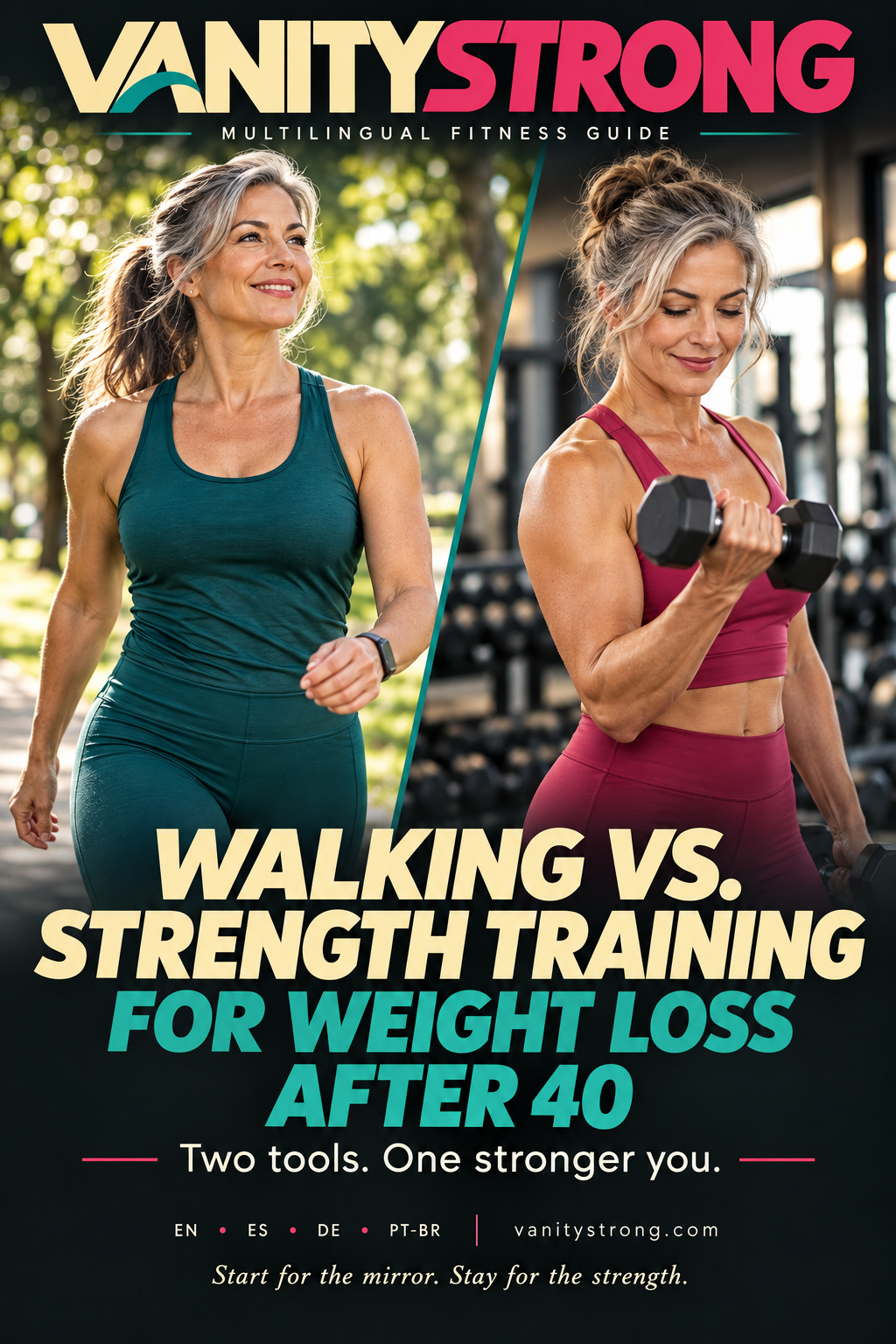
Available in all 8 site languages. Choose a language for its own PDF.
Should you walk more or lift weights if you want to lose weight after 40?
For most people, the useful answer is not one or the other.
It is understanding what each activity does best.
Walking is excellent because it is repeatable
Walking increases total physical activity without requiring much equipment or recovery.
A brisk walk can contribute to aerobic-fitness goals, burn energy and improve work capacity.
It is also easy to scale.
Ten minutes counts.
Thirty minutes counts.
Several short walks throughout the day count.
For people who have not exercised consistently, walking may be the easiest way to increase weekly movement without creating so much soreness that the plan collapses.
Walking or strength — what should you focus on?
Take the quick VanityStrong Fit Quiz and we’ll point you toward a practical starting place.
Strength training protects something dieting can cost you
When body weight decreases, not all lost tissue is automatically fat.
Muscle preservation matters.
Resistance training gives muscles a reason to remain strong while someone is trying to change body composition.
It also supports physical function and bone health.
That becomes increasingly relevant with age because muscle mass and strength tend to decline if they are not challenged.
Which one burns more calories?
That question is usually less useful than it sounds.
Different workouts burn different amounts of energy depending on body size, duration, intensity and fitness.
But sustainable weight management is not won by finding the single exercise with the highest calorie number on a watch.
Walking can often be performed more frequently.
Strength training creates a muscular stimulus that walking does not provide.
They complement each other.
After 40, muscle deserves more attention - not less
Muscle helps you remain strong enough for ordinary life.
It supports mobility and independence.
It also gives your body shape.
If your only strategy is to make the scale smaller, you may eventually achieve a lower number without building the body or capacity you actually wanted.
That is why a "fat-loss" plan should not treat resistance training as optional decoration.
A better weekly combination
A beginner might lift twice per week and walk most days.
An intermediate trainee might strength train three days and perform two or three dedicated cardio sessions while still walking regularly.
Public-health guidance generally recommends a combination of aerobic and muscle-strengthening activity rather than choosing only one.
Want the 7-day starter version?
Get the free 40+ Strength Reset guide by email — a practical first week of strength and walking you can actually follow.
- Seven simple days, one manageable step at a time
- A printable guide you can keep on your phone
- Free — no payment or account needed
Do you have to hit 10,000 steps?
No universal law requires exactly 10,000.
Use steps as a behavior tool, not a moral score.
If your current average is 3,500, moving toward 5,000 or 6,000 may be a more sensible first objective than forcing 10,000 immediately.
What about HIIT?
High-intensity interval training can be useful for people who enjoy it and are conditioned for it.
It is not mandatory for fat loss.
A program you can recover from and repeat is usually more valuable than a theoretically superior workout you avoid.
Nutrition still matters
Exercise contributes to weight management, but it cannot make energy intake irrelevant.
That does not require starvation or eliminating entire food groups.
It means matching your eating pattern to your objective while maintaining enough protein, micronutrients and total energy to support health and training.
Physical activity also produces major health benefits even when the scale does not change dramatically. U.S. guidance specifically emphasizes that exercise benefits health independently of body-weight change.
The answer
Walk because humans benefit from moving.
Lift because muscles need a reason to remain strong.
Adjust nutrition because body-fat change is not controlled by exercise alone.
And stop asking one type of exercise to do every job.
Sources & further reading
These references support the health and physical-activity statements in this article. No source endorses VanityStrong, its products, or its programs.
- National Institute on Aging - How Can Strength Training Build Healthier Bodies as We Age? — https://www.nia.nih.gov/news/how-can-strength-training-build-healthier-bodies-we-age
- Healthy People 2030 - Aerobic and Muscle-Strengthening Activity — https://odphp.health.gov/healthypeople/objectives-and-data/browse-objectives/physical-activity/increase-proportion-adults-who-do-enough-aerobic-and-muscle-strengthening-activity-pa-05
- U.S. Physical Activity Guidelines for Americans, 2nd Edition — https://odphp.health.gov/sites/default/files/2019-09/Physical_Activity_Guidelines_2nd_edition.pdf
Your next step
VanityStrong next step: use the Fit Quiz to find a strength program that fits your schedule, and pair it with regular walking. If nutrition is your bigger obstacle, explore the Meal Blueprint separately.
Ready to turn this into a routine?
Your quiz result points you to a VanityStrong program that fits your schedule, equipment and goals, so walking and strength training work together.
Not medical advice. VanityStrong provides fitness and general wellness education. It does not diagnose, treat or replace care from a qualified healthcare professional. If you are pregnant, managing a medical condition, or unsure whether exercise is appropriate for you, talk to your doctor first.