
The Free Fitness Starter Guide
Your Stronger Start
7 days to make movement feel possible again
Start for the mirror. Stay for the strength.
Free · 16 pages · Printable + fillable planner · No sign-in
Three lanes for real-life days
Simple seated & standing options
One seven-day planner to keep
01 / Start where you are
A beginning, not a test
You do not have to earn the right to move. You do not need to be younger, leaner, less busy or more motivated. This guide is a small invitation: find one version of movement that works today, then leave yourself a way back tomorrow.
Make the first week useful
Read the safety notes first. Choose a lane on page 3, borrow the flexible week on page 4, and use the movement notes to build confidence. The planner on pages 13–14 is yours to write on or fill in digitally. Seven days is an experiment in what feels workable, not a deadline for changing your body.
Before you begin
This is general education, not individualized medical advice or rehabilitation. If you have a health condition, recent surgery or injury, are pregnant or postpartum, or are unsure what activity is appropriate, ask a qualified healthcare professional about suitable movements and limits. Follow any existing care advice over this guide. Use a clear space, supportive footwear if helpful, and a stable chair without wheels, ideally against a wall. A countertop or wall used for support must not move.
Stop signals matter
Stop activity for chest pain or pressure, faintness, sudden or unusual breathlessness, new weakness, sharp pain or loss of balance. Seek urgent or emergency care for severe symptoms, chest pain, fainting or possible stroke symptoms; use your local emergency number. Persistent or recurring symptoms need appropriate clinical advice before trying again. Do not use effort ratings to explain away symptoms.
Your permission slip
You can shorten a session, stay seated, swap a day or rest. None of these choices makes the week a failure. The right starting point is one you can do safely and willingly—not one that proves your toughness.
Leave a little in reserve. Confidence is a better first-week target than exhaustion.
VanityStrong · Free Fitness Starter Guide · 2 / 16
02 / Redefine progress
Three lanes. One direction.
Progress can be starting without a long negotiation, finding a comfortable movement, or returning after a missed day. Changes in strength, stamina and body composition take time and vary; this week does not promise measurable transformation.
Gentle / a low-energy day
Try 3–5 comfortable minutes: seated marching, a few supported movements, or a short stroll. Pause freely. Aim for an easy effort around 2–3 out of 10, with full conversation comfortable. You may also choose rest. Gentle is a valid lane, not a lesser version of you.
Standard / an ordinary day
Try the 10-minute session on page 8 or a comfortable walk. Aim around 3–5 out of 10: working, but able to talk in sentences. Move slowly enough to control each repetition and breathe normally. Finish feeling you could do a little more.
Challenge / more room today
If the Standard version feels comfortable and you recover well, add a small amount of time or a few controlled repetitions—not both at once. An optional 12–15 minutes is enough for this example. Stay around 4–6 out of 10 and keep conversation possible. Challenge does not mean maximal effort, breath-holding or pushing through pain.
Use two simple checks
RPE means your personal rating of perceived exertion: 0 is resting, 10 is the hardest effort you can imagine. The talk test asks whether speaking is comfortable. These are rough guides, not medical screening. If effort suddenly feels unusual, stop and assess rather than chasing a number.
Track evidence, not judgment
Notice minutes you chose to move, how comfortable the movements felt, and whether the plan fitted your day. A scale reading is not a daily score. Before adding more, ask: could I repeat this without dreading it?
Choose the lane for the day you have. Changing lanes is good planning.
VanityStrong · Free Fitness Starter Guide · 3 / 16
03 / A flexible example
Your first seven days
This is a beginner example, not a required training schedule. Shift it to your week, keep recovery between strength days, and follow a purchased program’s workout instructions when you begin one.
Day 1 / meet the movements
Read pages 5–7. Try the Gentle lane: a few comfortable repetitions of a chair rise or seated alternative, a wall push-up or seated reach, and a short march. Take time to check the chair and support. Success is learning, not completing every pattern.
Day 2 / easy movement
Walk, roll or march for 3–10 comfortable minutes, together or in short bouts. Use a level familiar route; stay near a place to rest. Plan B: 2 minutes of seated marching with pauses.
Day 3 / recovery
Rest from planned strength work. Ordinary daily activity counts if comfortable. Prepare your chair or walking shoes for tomorrow. No make-up workout is owed.
Day 4 / a small strength session
Borrow the 10-minute session on page 8, or shorten it to your Gentle lane. Use the easiest versions that feel controlled. Plan B: one comfortable pattern and a minute of marching.
Day 5 / a little cardio
Repeat Day 2. If that was easy and recovery was comfortable, add 1–2 minutes. Otherwise repeat or reduce. A busy day may mean several brief movement breaks rather than one outing.
Day 6 / rest or easy enjoyment
Choose recovery, a relaxed stroll or comfortable mobility. Avoid turning this into an extra hard strength day. You can keep the habit alive by writing tomorrow’s realistic next action.
Day 7 / review, then choose
Look at the planner: which day, lane and setting actually worked? Repeat what helped next week. If you want another strength session, place it after adequate recovery rather than adding it automatically today. Choose a next action that fits your calendar.
Swap days, not punishments. If strength days become adjacent, insert recovery or move one.
VanityStrong · Free Fitness Starter Guide · 4 / 16
04 / Movement library
Stand up. Hinge gently.
These patterns help you practise everyday movements. Use a small comfortable range and stop before control fades. The illustrations show the idea; they are not a test of how low or far you must move.
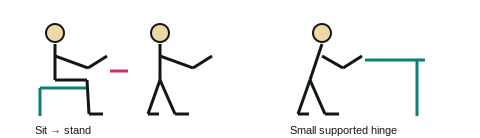
Chair sit-to-stand
Place a firm chair against a wall. Sit near the front with feet planted about hip-width apart. Lean your trunk slightly forward, bring your weight over your feet, then press through your feet to stand. Sit back slowly, finding the chair without dropping. Exhale as you rise; do not hold your breath. Start with 3–5 comfortable repetitions, then pause.
Make the chair rise easier
Use the armrests or a stable support if needed. A safely secured higher seat may help; do not stack loose cushions. You can practise only a small forward lean without standing. Fully seated option: gently press each foot into the floor, relax, and repeat while keeping your trunk comfortable. This is a different movement, not an equal strength dose.
Supported hip hinge
Stand near a stable countertop with a light hand on it. Soften your knees. Send your hips a little backward as if closing a drawer with them, allowing your trunk to tip as one unit. Return upright without leaning backward. Keep the movement small and your neck relaxed. Practise 3–5 slow repetitions; this is not a deep forward bend or a toe-touch.
Modify or skip
For the hinge, reduce the range if your back feels uncomfortable. Seated option: feet planted, hands on thighs, make a very small forward lean from your hips and return upright. Skip either movement if it produces pain, dizziness or unsteadiness. Ask for professional guidance if a comfortable version is not available.
Control on the way back matters as much as getting up.
VanityStrong · Free Fitness Starter Guide · 5 / 16
05 / Movement library
Push softly. Rise steadily.
A wall and stable support can make strength practice more approachable. Neither exercise needs to be deep, fast or exhausting to be worth learning.
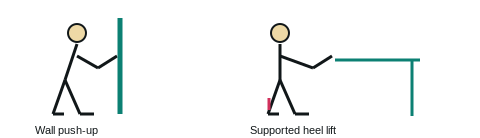
Wall push-up
Face a solid wall. Place palms at about shoulder height and slightly wider than your shoulders. Begin close to the wall, feet secure. Bend your elbows gently and let your body move toward the wall in one comfortable line, then press away. Keep shoulders relaxed and elbows angled slightly down rather than flared wide. Breathe out as you press. Try 3–5 slow repetitions.
Make the push easier
Stand closer and reduce the elbow bend. Stop for wrist or shoulder pain. Fully seated alternative: sit upright with feet supported, gently reach both hands forward at a comfortable height and return. No pushing force is required. This practises movement rather than replacing the wall exercise’s strength stimulus.
Supported calf raise
Stand facing a stable countertop or the back of a secured chair, with both hands available for support. Keep weight shared between your feet. Slowly lift your heels a little, pause only if steady, then lower with control. Keep knees relaxed and avoid rolling onto the outer edges of your feet. Try 3–5 repetitions before resting.
Seated calf raise
Sit with feet comfortably planted. Lift both heels while the fronts of your feet stay on the floor, then lower slowly. Use a smaller lift or alternate sides if that feels better. Avoid gripping with your toes or bouncing. No added weight is needed for this starter practice.
Your comfort check
Muscles working can feel warm or tired. Sharp, pinching or worsening joint pain is not a target. Use an easier version or stop; do not keep repeating a painful movement to finish a set. If pain persists, seek appropriate advice.
Make the movement easier before you make it faster.
VanityStrong · Free Fitness Starter Guide · 6 / 16
06 / Movement library
Steady feet. Easy rhythm.
Balance practice should reduce risk, not create it. Keep support within reach and your space clear. Walking, wheelchair rolling and marching can all be useful ways to add comfortable movement.
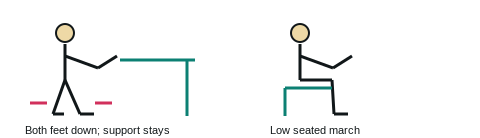
Gentle standing balance
Stand with feet hip-width apart beside a fixed countertop, both hands on it if needed. Slowly shift a little weight from one foot to the other while both feet stay on the floor. Return to the centre. Practise for 15–30 comfortable seconds, then rest. Look ahead and breathe normally. Do not close your eyes or remove support to make this harder.
Stay supported or seated
If standing feels unsafe, skip it. A seated alternative is a small weight shift with both feet supported and hands available on the chair; keep your trunk within a comfortable range. Do not attempt single-leg balance without appropriate support. Anyone with recent falls, marked unsteadiness or dizziness may need individually guided practice.
Walking or standing march
Choose a level familiar surface. Start slowly with short, comfortable steps. For marching, keep a stable support available and lift each foot only a little; high knees are unnecessary. Check that you can speak comfortably. Try a minute or two, with rests as needed.
Seated rhythm
Sit in a stable chair with feet supported. Lift one foot slightly and lower it, then switch sides. Keep shoulders relaxed and avoid leaning backward. If lifting a foot is uncomfortable, alternate gentle heel lifts or foot taps instead. Wheelchair users can choose comfortable rolling appropriate to their setup and existing guidance.
A safer finish
Slow down before stopping. Sit if you feel unsteady. Choose a route with seating, good lighting and no trip hazards. Holding support is a sensible choice, not a score to improve by letting go.
The goal is a comfortable rhythm with a safe way to pause.
VanityStrong · Free Fitness Starter Guide · 7 / 16
07 / Minimum viable movement
Ten minutes that count
No fitness equipment required: use a stable household chair and wall or countertop for support. This is a flexible practice session, not a personalized prescription. Seated options are welcome; the different versions do not promise identical training effects.
Minutes 0–2 / arrive
Check the space and your support. Start with comfortable walking, standing or seated marching. Move slowly enough to talk easily. If you are not feeling well, stop here and choose rest.
Minutes 2–4 / rise or press
Try 3–5 chair sit-to-stands, or seated foot presses. Rest for the remaining time. Repeat only if comfortable and controlled. The timer is a window for movement and rest, not a demand to exercise continuously.
Minutes 4–6 / push or reach
Try 3–5 wall push-ups, or comfortable seated forward reaches. Rest. Keep breathing and use a smaller range if needed. Skip a pattern that hurts rather than replacing it with a harder one.
Minutes 6–8 / steady lower legs
Try a few supported or seated calf raises. If appropriate, add a short supported weight shift with both feet down. You can use the entire window for rest, or repeat an earlier comfortable pattern instead.
Minutes 8–10 / ease out
Slow walk, roll or seated march, then settle. Notice how you feel. Write one realistic next action, such as ‘chair beside the table, Thursday after breakfast’. If symptoms appear, follow the stop guidance on page 2.
When ten is too much
The Gentle Plan B is 1 minute of easy marching, one comfortable pattern, and a pause. Even 2–3 minutes can be today’s useful starting point. Do not double tomorrow’s session to repay a short one. Return to your plan when you can.
You are practising showing up, not proving how much you can endure.
VanityStrong · Free Fitness Starter Guide · 8 / 16
08 / Build stamina gently
A walk with room to grow
Start with what you can recover from. Cardio can be walking, rolling, seated marching, cycling or another comfortable option that suits your access needs—not only a brisk outdoor walk.
Find a repeatable starting point
Choose 3–5 easy minutes, or less if needed. Split them into short bouts with rests. Use the talk test: conversation should be comfortable. For outdoor walks, choose a level route with a turn-back point; check the weather, lighting and footwear. Carry any usual mobility aid and follow your existing care advice.
Build one thing at a time
Repeat that duration on several days. If you feel comfortable during it and recover well afterward, add 1–2 minutes to one outing. Keep the pace easy while adding time. If you are unusually tired, sore or breathless, reduce the next outing and seek advice for persistent or concerning symptoms. There is no automatic weekly increase.
Three everyday versions
Gentle: 2–5 easy minutes or seated rhythm. Standard: about 10 comfortable minutes, possibly split into two outings. Challenge: a little longer only when the shorter version is well tolerated. These are examples, not minimum requirements. Your starting point may be below them.
The long-term direction
WHO public guidance for adults points toward 150–300 minutes of moderate aerobic activity per week, or 75–150 vigorous minutes, plus muscle strengthening on at least 2 days. Older adults are also advised to include varied balance and strength activity on 3 or more days to support function and prevent falls. This is a long-term public-health direction, never a must for week one. Some activity is better than none; suitability and progression are individual.
Make room, not pressure
Link a short bout to a routine: after breakfast, between calls, or before an evening shower. If the day is busy, keep the smaller version. The habit should fit your life before you ask it to grow.
Repeat comfortably first. Add minutes later.
VanityStrong · Free Fitness Starter Guide · 9 / 16
09 / Food that fits real life
A plate, not a rulebook
You do not need a perfect diet to begin moving. Use a simple meal structure to make ordinary choices easier. Foods, portions and meal timing should fit your appetite, culture, access and medical needs.
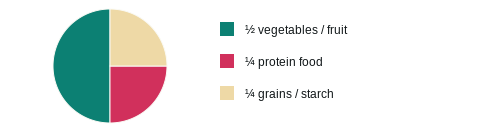
Use a flexible visual
For many main meals, picture roughly half the plate as vegetables and/or fruit, a quarter as a protein food, and a quarter as grains or another starchy food. Add fat, sauce or seasoning you enjoy. This is a planning cue, not a calorie target or a requirement to measure food. Mixed dishes count: look for those ingredients across the meal rather than separating them.
Three combinations for an ordinary week
1. Rice bowl: rice, canned beans or tofu, frozen vegetables, and a spoon of salsa or a little olive oil. 2. Quick eggs-and-toast meal: eggs or a bean scramble, wholegrain toast, tomatoes or cooked greens, and fruit if wanted. 3. Shared family dinner: chicken, lentils or fish; potatoes or pasta; and a side of vegetables, with the same base meal for everyone. Choose foods that suit allergies, preferences and availability.
Make the easy meal easier
Keep one protein option, one starch and one produce option you can assemble without a long recipe. Frozen vegetables and canned foods can be practical choices. Rinse canned beans if you prefer; check labels when you need to limit sodium or other ingredients. Reuse leftovers safely according to local food-safety guidance.
No punishment meals
Do not skip a meal to make up for a missed workout, or use exercise to earn food. A more useful question is ‘what can I add that makes this meal satisfying?’ If you need a therapeutic diet or have concerns about eating, seek qualified support rather than following a generic plate diagram.
Write one meal you can actually make on your busiest day.
VanityStrong · Free Fitness Starter Guide · 10 / 16
10 / Keep the return easy
Water. Rest. Return.
Recovery is part of training, not a reward for doing enough. Your plan needs ordinary meals, comfortable hydration and space to rest—especially while learning new movements.
Hydration without a universal quota
Keep water accessible and drink regularly, including around activity. Heat and longer activity may increase needs. Thirst and urine colour can offer clues but are imperfect, especially for older adults or with medications. No single litre target suits everyone. If a clinician has advised a fluid limit for heart, kidney or another condition, follow that guidance. Most short easy sessions do not require sports drinks.
Give sleep a chance
Adults generally need around 7–9 hours of sleep, though needs and circumstances differ. Protect a realistic wind-down time and a reasonably consistent wake time when possible. After poor sleep, choose Gentle or recovery rather than forcing Challenge. Persistent sleep problems or excessive daytime sleepiness deserve appropriate advice.
Understand next-day feedback
Mild muscle soreness after unfamiliar activity can happen, but soreness is not proof of a better workout. If it limits everyday movement, reduce the dose and allow recovery. Sharp pain, swelling, worsening symptoms or persistent pain are reasons to seek advice. Plan recovery between beginner strength sessions rather than repeating them hard on consecutive days.
Missed a week? Return, not restart
Do not begin with a catch-up session. Check why the plan stopped: timing, energy, access or discomfort. Remove one obstacle, choose the Gentle lane, and try one short comfortable session. If illness or injury caused the break, follow suitable recovery advice before returning. Resume gradually rather than assuming your previous dose still fits.
Use a no-punishment mode
Normal week: the example plan. Busy week: fewer or shorter bouts. Low-energy week: Gentle or rest. All three modes keep the next action visible. None requires earning your way back.
The most useful plan includes the day when the plan does not happen.
VanityStrong · Free Fitness Starter Guide · 11 / 16
11 / Questions worth asking
You are allowed to adapt
There is no single correct beginner. These answers help you decide what to try, what to change and when to ask for help.
Does a short session really count?
Yes. It contributes movement and helps you practise a repeatable habit. It is not a promise that a few minutes produces the same results as a longer structured program. Start with the dose that is comfortable and build when appropriate.
What if I cannot get down to the floor?
You do not need floor exercises for this guide. Choose the supported standing or seated options. When selecting a paid program, read the actual position and equipment requirements; do not assume a ‘beginner’ label means fully seated or floor-free.
Should I feel sore or sweat?
Neither is a required marker of success. Temperature, clothing, fitness and the activity affect sweat. Judge comfort, control and recovery instead. Pain or unusual symptoms are not a badge of effort.
Can I start at 40, 60 or later?
Many adults can benefit from appropriate activity at any age. Your suitable starting point depends on current capacity and circumstances, not age alone. If you are unsure or have symptoms, get individualized guidance.
What if I miss two days?
Do the next realistic action; do not squeeze missed sessions together or double repetitions. Keep recovery between strength days. A brief return is more useful than a punishment plan.
Will this make me lose weight?
This guide does not promise weight loss. Body weight is influenced by many factors. Movement can support health, strength and daily function regardless of whether weight changes. Seek qualified help for individualized nutrition or weight concerns.
Do I need an account or newsletter subscription?
No. This guide and its PDF are freely accessible without sign-in or another subscription. A free account and marketing emails are separate choices. A paid program is optional; review its details before deciding.
If a version does not fit, adapt it. If symptoms do not make sense, ask for help.
VanityStrong · Free Fitness Starter Guide · 12 / 16
Bonus / Your seven-day planner
Make a week you can return to
Use this spread as a plan and a record—not a report card. Choose calendar dates yourself. Write a few words in each space, leave blanks if you prefer, and never turn missed minutes into debt.
Before Day 1
Pick one realistic time and a safe place. Decide your likely lane and a smaller Plan B. Example: ‘Thursday after breakfast; 5 minutes; chair and wall; Plan B is 1 minute seated marching’.
Your notes belong to you
Minutes can be planned or completed—mark which. Mood/energy is your own description, not a diagnosis. A rest day can say ‘rest’. Use the PDF form fields in a compatible reader or print and write by hand. Save your filled copy to your own device; this guide does not submit your entries to VanityStrong.
A realistic next action names a time, a place and a small step.
VanityStrong · Free Fitness Starter Guide · 13 / 16
Bonus / Keep the next step visible
Finish with a useful next action
Continue the same week here. There is no streak to protect. A quieter day can give you information about what the next week needs.
A two-minute review
Which movement felt comfortable? Which time actually worked? What made the week harder than expected? Keep one helpful choice, remove one obstacle, and make one small adjustment. You do not need to change everything at once.
Next week, in one sentence
‘On ___ after ___, I will ___ for about ___ minutes. If that does not fit, my Plan B is ___.’ Choose your recovery days too. If you start a paid program, use its workout and rest instructions rather than adding this example on top.
Return to a workable plan—not to a verdict about yourself.
Use your browser’s print dialog to print or Save as PDF. Entries stay on this page and disappear when you leave or refresh; save a copy if you want to keep them.
VanityStrong · Free Fitness Starter Guide · 14 / 16
12 / Choose with confidence
Find a program that fits
A guide helps you start. A suitable structured program can give you workout instructions and progression to follow. Review the real program page before buying; no quiz result can guarantee an individual fit.
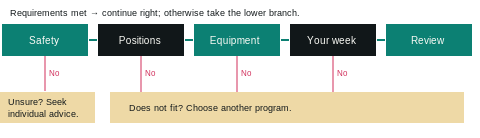
1 / Do you need individual guidance first?
If symptoms, a recent injury, a health condition or uncertainty make activity suitability unclear, consult an appropriate professional first. A fitness quiz is not a medical assessment. You can return to browsing when you know your limits.
2 / Which positions are practical?
Need fully seated or supported, floor-free movement? Look for explicit descriptions that meet that need. Comfortable standing and getting to the floor? Review the exercise format anyway. Do not infer accessibility from a cover photo or the word beginner.
3 / What do you actually have?
Compare every required item with your equipment: a chair is not a weight bench, and gym access does not mean you own bands or dumbbells at home. If a required item is missing, choose another program or confirm an explicitly supported alternative. Do not improvise unstable substitutes.
4 / What does an ordinary week allow?
Match days per week, session length and experience level to a normal week—not your most ambitious week. Check the program’s duration, recovery instructions, current price and what access includes. If the schedule is unrealistic, choose a simpler fit.
5 / Review before paying
Use the VanityStrong Fit Quiz as a starting point, then read the recommended program details and the checkout terms. One-time purchased plans remain available permanently. Subscription fitness access lasts while the paid membership is active. All Access covers fitness plans; Meal Blueprint is sold separately. No purchase is required to use this guide.
The right offer is one you can use—not just one you want to be ready for.
VanityStrong · Free Fitness Starter Guide · 15 / 16
13 / Your next chapter
Start for the mirror. Stay for the strength.
You have a week to try, movements to adapt, a smaller session for busy days and a way to return. That is already a more useful starting point than waiting for a perfect Monday.
If you want a little direction
Take the free Fit Quiz at vanitystrong.com/quiz. Use the result to explore a program, not as a medical recommendation or a promise of results. Review the equipment, format, schedule and current price on the program page before deciding.
If you prefer to browse
Visit vanitystrong.com/programs to compare real training programs. Choose only when the requirements and your week line up. Paid programs are optional; this guide is yours to keep and use without buying anything.
If today is not a buying day
Choose the next action from your planner and keep it small. Repeat the easiest comfortable version. You can return to VanityStrong when you want more structure—no deadline, invented discount or catch-up obligation.
Sources and scope
Public guidance: WHO Guidelines on Physical Activity and Sedentary Behaviour (2020) and WHO Physical Activity fact sheet; USDA MyPlate for the flexible plate concept; CDC About Sleep for general adult sleep direction. These sources support the broad guidance, not an endorsement of VanityStrong or individualized exercise clearance. Reviewed editorially in November 2026. Movement diagrams are original VanityStrong educational artwork.
One small action. A realistic week. A way back.
VanityStrong · Free Fitness Starter Guide · 16 / 16