
Free guide
No Floor Required.
The No-Floor Fitness Guide: Strength, Balance & Mobility for Real Life
Real training, no floor required. Explore seated and supported strength, balance and mobility, a five-minute reset, and practical ways to move through daily life.
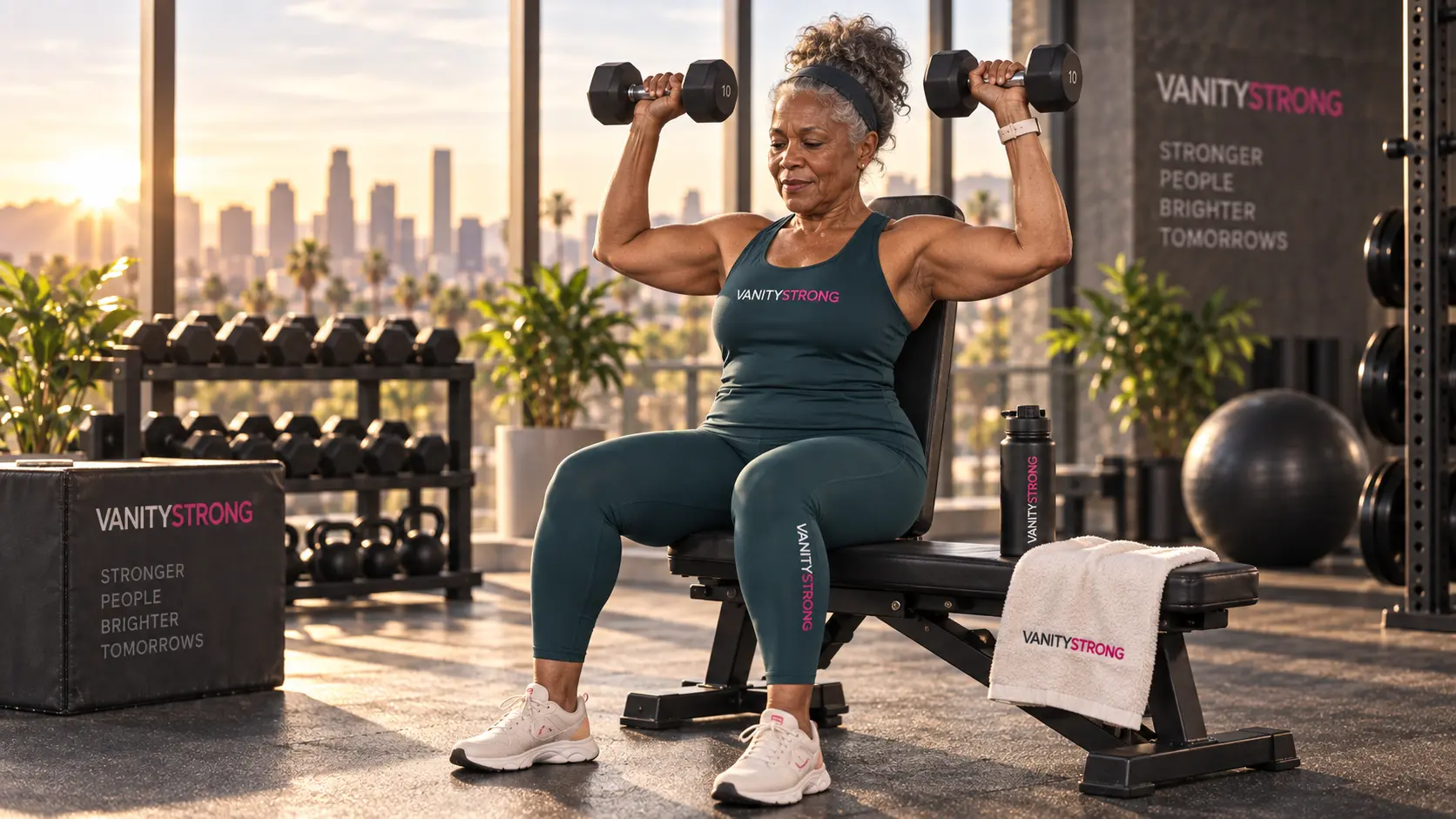
A seated workout is a workout. A wall can be your training partner. A sturdy chair can make strength work more accessible without making it less legitimate. You do not need to get down on the floor to give your muscles useful work. This guide is for adults 18 and over who want movement that fits their body and their life—not a test of whether they can copy somebody else. You might be managing stiffness, living in a larger body, rebuilding confidence, navigating a temporary limitation, or simply prefer to stay upright. You belong here. In your 50s, 60s or 70s, strength still deserves a place in your life. So does it at 28. The goal is not to fix your identity or prove your toughness. It is to find a way to train that you can return to.
Choose your movement lane today
Choose a position you can use comfortably today. This is a preference, not a medical assessment. You can change it whenever you need; your choice stays only on this device.
What are you actually training for?
Think beyond a workout score. Getting out of a chair uses leg strength, coordination and a little forward weight shift. Carrying groceries asks your hands, arms and trunk to share the load. Reaching toward a shelf calls for comfortable shoulder movement and control. Stairs and curbs combine leg effort with confidence in your footing. Getting into a car can involve turning, moving a leg and managing a changing seat height. Travel adds waiting, carrying and longer periods in one position. These are useful reasons to train, even if appearance is also part of your motivation.
Choose one everyday task that matters to you. Perhaps it is carrying a small bag without feeling rushed, moving around the kitchen more comfortably, or staying engaged on an outing. That task is a direction, not a guaranteed outcome. Exercise does not remove every barrier: access, pain, fatigue, equipment and your environment also matter. But it can give you a practical place to begin. Notice ease, control and confidence as well as repetitions. Your body is allowed to have more than one scoreboard.
The five capacities that matter
Lower-body strength: knees, hips and ankles contribute to standing, changing position and moving. A seated knee extension or a supported chair rise can train different parts of that picture. Not everyone needs or can use the same pattern.
Push and pull strength: pressing and rowing ask your arms, shoulders and back to work against resistance. That resistance may be very light. The important part is a movement you control—not the size of the weight.
Mobility and range: explore positions you can enter and leave comfortably. Mobility is not a contest for the deepest stretch. Smaller, repeatable movement can be more useful than forcing an impressive-looking position.
Balance and control: manage your position with the support you need. Seated postural control is meaningful too. Standing balance work is optional, should stay close to reliable support, and should not include eyes-closed challenges or deliberately unstable surfaces.
Stamina: sustain a manageable amount of activity, then recover. Seated arm movement, suitable wheeling, walking or another accessible activity may fit. Strength, balance, mobility and stamina complement one another. No single exercise covers everything.
Set up a space that works for you
Use a sturdy chair that does not slide or roll, with enough room for your body and feet. Keep the area clear of rugs, cords, pets and bags. A counter used for support must be fixed and able to take the pressure you apply. A wall should be clear and dry. Do not use a lightweight table or towel rail as a support. If using a wheelchair, use the appropriate stability and brake setup for your own chair; seek qualified guidance if you are unsure.
Place equipment within reach before starting. Check bands for cracks or damage and do not attach them to uncertain fixtures. Choose footwear or another setup that gives you reliable contact with the surface. Allow space to turn or change position without rushing. Plan how you will sit down or pause. If a transition feels uncertain, keep the whole session seated. Preparation is not a detour from training. It is what makes the training repeatable.
The No-Floor Movement Menu
These are examples, not a prescription or a complete training program. Try one or two suitable movements first. Use an easy, controlled range and rest before technique changes. For strength examples, a few comfortable repetitions can be enough to explore the movement; you do not need to fill an entire minute. Keep breathing rather than bracing and holding your breath. A movement that does not suit you can be replaced or skipped. If neither variation fits your abilities, an appropriately trained professional can help you find an alternative.
01
Knee extension / chair rise
Move slowly and avoid snapping the knee straight. Keep your available support close.
- Seated option
- Sit with support as needed. Extend one knee through a comfortable range, then lower. Alternate sides; do not force a locked-out position.
- Supported option
- From a sturdy chair, lean slightly forward and stand only if this is appropriate for you, using a fixed support or armrests as needed. Sit back down with control. A partial rise is an option.
- Optional progression
- Add one controlled repetition or a slightly slower lowering phase. Do not remove support just to make the exercise harder.
02
Row / shoulder-blade draw
Let shoulders stay away from your ears. Keep your trunk comfortable; do not yank backward.
- Seated option
- Draw elbows gently back without resistance, then return. If you already have a safe, familiar band-row setup, use light tension.
- Supported option
- Use a stable support with one hand and make a small rowing motion with the other arm. Light resistance is optional only if you can maintain your position.
- Optional progression
- Pause briefly with elbows back, or use a little more resistance after the setup and technique are reliable.
03
Forward press / wall push-up
Keep wrists comfortable and shoulders relaxed. Exhale as you press.
- Seated option
- Press empty hands forward from your chest and return. Keep the reach smaller if needed. A light familiar resistance option may be used if appropriate.
- Supported option
- Face a wall, hands at a comfortable height. Bend elbows slightly to move toward it, then press away. Keep feet planted and use a small range.
- Optional progression
- Slow the return. A greater wall distance changes the demand; use it only if footing and control remain reliable.
04
Heel and toe raises
Move at the ankles without rocking your whole body. Use a range that feels comfortable.
- Seated option
- With feet supported, lift heels and lower them. Then gently lift the front of each foot with heels down. Skip any position that does not fit your mobility.
- Supported option
- Hold a fixed support with both hands. Raise heels a little, then lower slowly. Keep your weight balanced; you do not need to rise high.
- Optional progression
- Add a short pause or a few repetitions. Single-leg versions are not required.
05
March / alternating reach
Stay tall without stiffening. Keep a steady pace and continue breathing.
- Seated option
- Lift one foot a little if appropriate, then the other. If leg movement does not suit you, alternate comfortable forward arm reaches instead.
- Supported option
- Hold a fixed support and make small alternating foot lifts, or keep feet planted and alternate arm movement with suitable support.
- Optional progression
- Extend the comfortable work period slightly. Keep the pace easy enough to speak in full sentences.
06
Comfortable reach and return
Keep the movement in front of you and below any uncomfortable shoulder height. Avoid leaning beyond a stable base.
- Seated option
- Reach one hand forward a short distance, then return. Alternate arms while your seat and feet remain supported as needed.
- Supported option
- Keep one hand on a fixed support and reach the other forward within easy range. Switch sides only when your setup is secure.
- Optional progression
- Make the same range smoother, or add a brief pause. An overhead reach is not a requirement.
07
Position control / gentle weight shift
Support is part of the exercise. Do not practice near your limit or deliberately test a fall.
- Seated option
- With appropriate back and foot support, make a small change in upright position and return to a comfortable centre. Avoid this if trunk control requires individualized guidance.
- Supported option
- With both hands on a fixed support and both feet down, shift weight a little from one foot toward the other. Return to centre without lifting a foot.
- Optional progression
- Use smoother control or a slightly longer pause. Reduced hand support is optional only when appropriate and advised—not a badge to earn.
08
Light hold / everyday carry preparation
Keep the load close and shoulders comfortable. Place the object down before your grip or position becomes unreliable.
- Seated option
- Hold a small, manageable object beside you or close to your trunk for a few breaths, then put it down. Use empty hands if resistance is not suitable.
- Supported option
- Stand beside a fixed support and hold a very light object with the other hand if appropriate. Stay still; walking with a load is not required.
- Optional progression
- Hold a little longer before considering a heavier object. Do not combine carrying with a balance challenge.
The 5-Minute Floor-Free Reset
One minute per movement means a minute of available time—not a minute of nonstop effort. Try 20–30 seconds of gentle movement, then rest for the remainder. Shorten or skip anything that does not fit. This reset is a movement break, not your full strength prescription. Check off a movement after trying a suitable version; the marks stay on this device and can be cleared.
Email me the 7-Day No-Floor Starter Plan + printable tracker
A short sampler, space to note your movement lane and a printable checklist—plus the full guide PDF. Use the existing guide form below; newsletter consent is separate and optional. The download is available here even if the delivery email cannot be sent.
Download the full guide PDF ↓Movement snacks: fit training into real life
A three-to-ten-minute bout can be easier to start than a session that requires an empty afternoon. Connect it to a reliable moment: after morning coffee, between calls, while dinner cooks safely, or after a long period sitting. You do not need to compensate later for choosing a short session. Short bouts can contribute to your overall activity, but a few movement snacks alone may not provide all the strength or aerobic work you need. Think of them as building blocks, not a loophole or a promise.
Five minutes: use the reset with plenty of pauses. Ten minutes: take two minutes to settle in, explore two suitable strength examples for about three minutes each with rest, then use two minutes of comfortable mobility. Fifteen minutes: settle in for two minutes, spend six minutes on two or three suitable strength examples with rest, use three minutes for position control or mobility, then four minutes for easy stamina movement or recovery. These are time containers, not mandatory doses. You can stop early or use the entire time for just one task.
Mix positions only if transitions are comfortable. Seated for the entire session is a complete choice. Avoid juggling a phone, weights and a support at the same time. Put the guide where you can read it, prepare your space, and let the session stay simple. A plan that requires perfect conditions is unlikely to survive an ordinary Wednesday.
Make it harder without making it complicated
When a movement feels controlled across several sessions and recovery is manageable, change one thing. Add a repetition. Lower slightly more slowly. Explore a little more comfortable range. Use light resistance. Add one short round with rest. You do not need to improve all of them at once. Write down the change so you can see whether it helped. A harder variation is useful only if you can still perform it well and return to normal daily activity afterward.
Support is different from resistance. Removing a hand can turn a strength exercise into a balance challenge without helping you train the intended muscle. Keep support when it lets you use better technique. Reduce it only if appropriate for your ability and, when needed, with professional guidance. Never use unstable surfaces or eyes-closed tasks to chase intensity. Progress can also mean the same exercise feeling more familiar. That is information, not a reason to immediately double the workload.
Make it easier without calling it failure
Use a smaller range. Add support. Slow the overall pace. Choose the seated option. Do fewer repetitions. Rest longer. Use empty hands instead of weights. Change the movement entirely. None of those choices makes the session dishonest. The purpose of a modification is to make useful training possible—not to make you apologize for your body. Some days the smartest adjustment is to stop and ask for guidance.
Choose the version you can control today, not the version you hope to earn. If a session leaves you too tired for the rest of your day, the next session may need less work. If one movement is uncomfortable, do not treat every movement as forbidden or try to push through that one. Pause, adapt and seek appropriate advice when needed. A capable training plan makes room for variability. It does not demand that you pretend variability has disappeared.
Confidence comes from repeatable decisions
Start with a session small enough that you are willing to do it again. Put your chair in a reliable place. Keep your band or light weights accessible, but safely stored. Choose a normal-day version and a lower-energy version before the lower-energy day arrives. Your minimum might be one comfortable movement and a note about what you need next time. That minimum is not a full program; it is a way to keep the decision simple.
Missing a day does not require starting your life over. Return at a manageable level. Do not double the next workout as repayment. Track what you tried and how it felt rather than chasing soreness or an unbroken streak. Notice whether your setup is easier, whether you remember the cues, and whether you feel more comfortable asking for an adaptation. Confidence is not always a dramatic before-and-after. Sometimes it is knowing what to do on an ordinary day.
Your next step
Take the Fit Quiz first to explore a starting point for your goals, equipment and mobility preferences. Then review the recommended program before deciding whether to buy. The quiz is not a clinical assessment and cannot determine medical suitability. A structured program adds progression, scheduling and substitutions beyond this sampler. All Access is an optional way to access fitness plans; Meal Blueprint is sold separately.
Explore All Access →Questions about no-floor fitness
Is seated exercise real strength training?
Yes, when muscles work against an appropriate resistance. Position alone does not decide whether training is legitimate. Empty-hand movement can be a useful starting point, but progressive strength usually needs a suitable challenge over time.
Can I train without ever getting on the floor?
Many strength, mobility and stamina activities can be done seated or upright. Your options depend on your abilities and setup. Floor-free does not mean every movement is suitable for everyone.
Is this only for older adults?
No. This guide is for adults 18 and over. Older adults may find the real-life focus useful, but adaptations also serve younger people, larger bodies, temporary limitations and personal preferences.
What if standing balance feels uncertain?
Choose seated examples and keep appropriate support. Do not test your balance at the edge of your ability. A qualified clinician or appropriately trained exercise professional can help with individual needs.
Do I need weights or a resistance band?
Not to explore the examples. Start with comfortable movement and a secure setup. Light resistance can be introduced when appropriate. Bands need a safe setup and must be checked for damage.
Will five minutes replace a full exercise program?
No. It is a practical movement break and starting point. Overall fitness usually benefits from a broader, repeatable mix of strength, stamina and suitable mobility and balance work.
What if a movement hurts or I cannot do it?
Stop that movement. Do not force a position or push through sharp or unusual pain. Skip or replace it and seek qualified advice when symptoms are new, concerning or persistent.
How do I choose the next program?
Begin with the Fit Quiz, then review your recommendation and the program's equipment, format and suitability. A recommendation is a starting point, not medical clearance. Get individualized guidance where needed.