
Training Basics
How to Start Exercising Again After a Long Break Without Trying to "Make Up" for Lost Time
The biggest mistake people make after a long break from exercise is trying to prove that the break never happened.
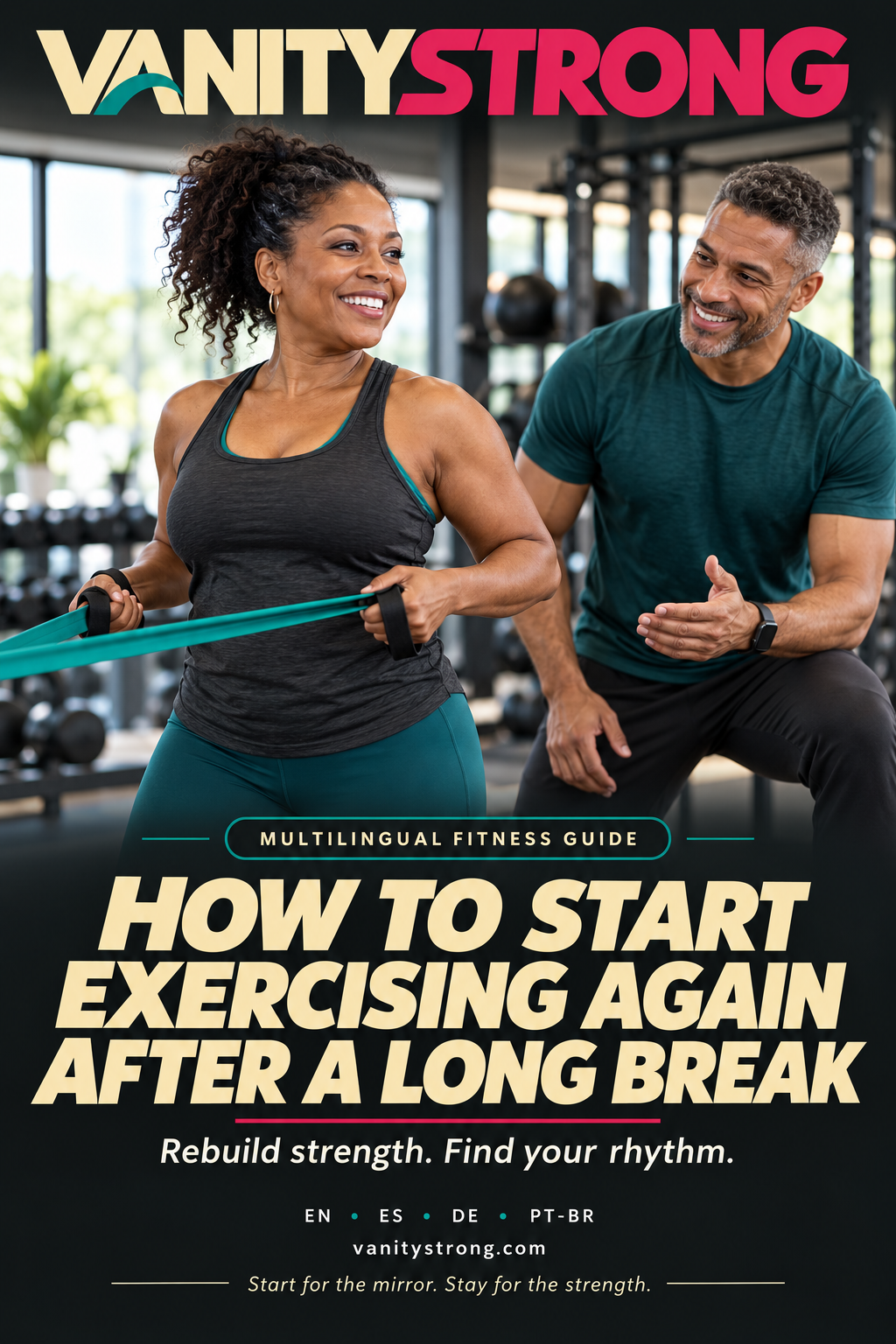
Available in all 8 site languages. Choose a language for its own PDF.
Find a practical starting point
Take the VanityStrong Fit Quiz for a starting place that fits your schedule, equipment and goals.
The biggest mistake people make after a long break from exercise is trying to prove that the break never happened.
They return to the weights they used two years ago.
They run the distance they used to run.
They train six days because they feel guilty about six inactive months.
Then soreness, fatigue or an injury turns a comeback into another interruption.
Starting again works better when you stop trying to repay the past.
Your old fitness still matters - but it is not your current fitness
Previous training experience can help.
You may remember movement patterns. You may regain strength faster than a true beginner. You may understand what hard effort feels like.
But your present training load should still match your present capacity.
If your cardiovascular fitness, strength or mobility has declined, pretending otherwise does not accelerate progress.
Week one should feel almost too easy
The goal of the first week is not transformation.
The goal is to complete it and remain capable of doing week two.
A returning beginner could perform two short full-body strength sessions and three easy walks.
Leave repetitions in reserve rather than training every set to failure.
Choose weights you control.
Finish sessions feeling as though you could have done more.
That is restraint, not weakness.
Rebuild strength with simple movement patterns
A comeback program does not need 18 exercises.
Use a squat or chair stand, hip hinge, push, pull, carry and core exercise.
Two sets per movement may be enough initially.
Gradually increase weight, repetitions or sets over several weeks.
Muscle-strengthening exercise is recommended at least twice weekly for adults, and starting light before building toward that target is appropriate for inactive people.
Rebuild cardio separately
Walking is one of the simplest tools for restoring endurance.
Start with a duration you can repeat.
That may be 10 minutes.
It may be 30.
The number matters less than whether it is appropriate for your current condition.
Over time, increase duration, pace or frequency.
The long-term public-health target is at least 150 minutes of moderate aerobic activity per week, but people who are inactive are encouraged to start smaller and build.
Soreness is not a score
A workout does not become more effective because stairs are miserable the next day.
Some soreness can happen when you return to training. Severe soreness that repeatedly disrupts normal life usually means the session exceeded what was necessary.
A good comeback plan leaves room for adaptation.
Use a six-week mindset
Weeks one and two are about showing up.
Weeks three and four are about gradually increasing work.
Weeks five and six are where you begin training more normally.
That progression is usually more productive than a heroic first Monday followed by ten days of recovery.
What if you miss another week?
Resume.
Do not punish yourself.
You do not lose your identity as an active person because life interrupts your schedule.
Fitness that only works when life is perfect is not a very useful form of fitness.
Example comeback structure
Weeks one and two: two strength days, three easy walks.
Weeks three and four: two or three strength days, three moderate walks or cardio sessions.
Weeks five and six: three strength days if recovery is good, plus cardio appropriate to your goals.
Every stage can be adjusted.
Someone returning from illness, surgery, pregnancy, injury or a significant chronic condition may need professional guidance before following a generic comeback plan.
Motivation comes after evidence
Do not wait until you feel like your old self.
Collect evidence that you are becoming active again.
Finish the first workout.
Take the walk.
Repeat it next week.
Confidence usually grows from completed actions.
Sources & further reading
These references support the health and physical-activity statements in this article. No source endorses VanityStrong, its products, or its programs.
- U.S. Office of Disease Prevention and Health Promotion - Physical Activity Guidelines Q&A — https://odphp.health.gov/our-work/nutrition-physical-activity/physical-activity-guidelines/about-physical-activity-guidelines/questions-answers
- Healthy People 2030 - Aerobic and Muscle-Strengthening Activity — https://odphp.health.gov/healthypeople/objectives-and-data/browse-objectives/physical-activity/increase-proportion-adults-who-do-enough-aerobic-and-muscle-strengthening-activity-pa-05
Your next step
VanityStrong next step: start with the free Beginner Restart, then use the Fit Quiz to move into a longer plan such as Women's Reset 30 or Men's Reset 30.
Ready for your next step?
Take the VanityStrong Fit Quiz for a starting place that fits your schedule, equipment and goals.
Not medical advice. VanityStrong provides fitness and general wellness education. It does not diagnose, treat or replace care from a qualified healthcare professional. If you are pregnant, managing a medical condition, or unsure whether exercise is appropriate for you, talk to your doctor first.